Wednesday, 31 July 2013

Norfolk Bat Survey at Rocklands: exciting first results!

To my surprise, the BTO have already processed the data from the first O. S. grid square that I collected as part of their Norfolk Bat Survey. They sent me an interesting resumé, the highlights of which appear below.

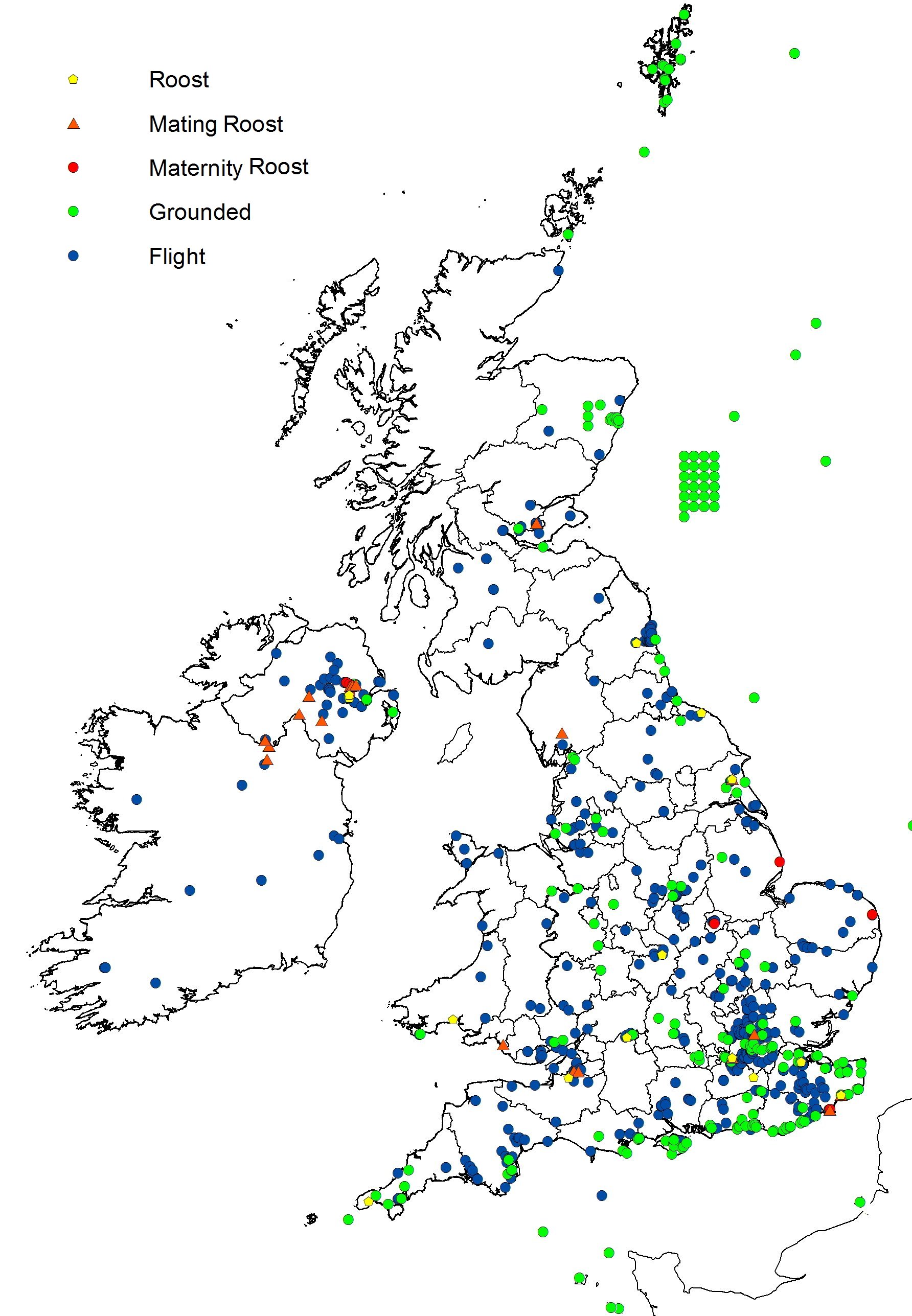
On the inaugural night of 25 July the recorder was located in a garden by an old clay-lump cottage along Green Lane. All three pipistrelles were recorded including the scarcest, Nathusius' Pipistrelle. There have been fewer than 850 British records of this bat (fide http://www.nathusius.org.uk) which was first reorded in Norfolk just 15 years ago; it's known UK distribution is plotted here (copied below).

All known UK records of Nathusius' Pipistrelle Pipistrellus nathusi (source: http://www.nathusius.org.uk/Distribution.htm)
Another uncommon bat, Serotine, was the fourth species. In the UK, it occurs south of a line from Cornwall to The Wash and classically roosts in old buildings, often churches. Its populations are declining.

The following evening, St. Peter's Church produced six confirmed species of bat. The Barbastelle  was the highlight. Its UK population is estimated to be c. 5000 and decreasing, and it is considered Near Threatened internationally.

Barbastelle Barbastella barbastellus UK distribution (source: http://jncc.defra.gov.uk/publications/jncc312/species.asp?FeatureIntCode=S1308)

Serotine was present once again. The other species were Noctule, Common and Soprano Pipistrelles and Brown Long-eared Bat. Nathusius' Pipistrelle may have been recorded too.

Bat detector @ St Peter's Church, Rocklands
A complex of old clay-lump barns and outbuildings next door to the church, which used to hold good numbers of bats, are in the process of renovation. Hopefully, mitigation measures have been taken to ensure that the bats are able to find new roost sites.

Saturday, 27 July 2013

Butterfly Conservation's Big Butterfly Count

Once again this year, I've been taking part in Butterfly Conservation's Big Butterfly Count. The best location so far has been Great Hockham Hills and Holes (today largely planted with exotic pines). A broad patch of grass and flowers at the first bifurcation of the track held 14 species of butterfly and day-flying moth:-

Common Blue Polyommatus icarus, Great Hockham Hills and Holes.
Silver Y - 1
Six-spot Burnet - 1
Blackneck - 1, a local moth
Small Skipper - several
Essex Skipper - several
Large White - 1
Green-veined White - 2
Common Blue - 1
Small Tortoiseshell - 1
Peacock - 2
Comma - 1
Gatekeeper - 3
Meadow Brown - 5
Ringlet - 7

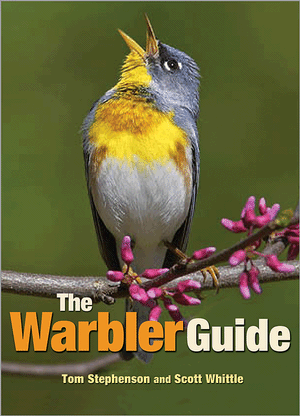
The Warbler Guide: downloadable 'quick finders'


Princeton University Press, publishers of the outstanding new guide to North American warblers, The Warbler Guide, have made available some helpful charts summarising visual identification features of the species - just in time for fall migration! These images appear at the start of the book. The files can be donwloaded from the Princeton University Press blog in .PDF and .JPG format.

I will no doubt be reviewing this book as soon as I can get hold of a copy.

Friday, 26 July 2013

Bee Orchid on Chapel Green, Rockland St. Peter

I managed to overlook this plant when it was flowering but, thanks to Margaret Neale who runs the village's wonderful Rylstone B&B, I did eventually track down this fruiting Bee Orchid Ophrys apifera on Chapel Green next to our house.


Harold Neale's photograph of the same plant, taken when they found it 17 days earlier on 9th July, is a bit more impressive...


The presence of this species on our tiny plot of meadowland is a good indicator of the importance for conservation of even these small areas of appropriately-managed grassland.

Sunday, 21 July 2013

Neotropical Birding 13 goes to press

Neotropical Birding 13 has just been sent to our printers, in good time for distribution at this year's Birdfair. Please visit the Neotropical Bird Club stand.


Welcome to issue 13 of Neotropical Birding!

We begin in Central America, where our cover story is an Identification workshop on the vocalisations of Unspotted Saw-whet Owl executed by regular contributor Knut Eisermann.

Steve Howell has contributed many scholarly articles to the Club’s journals, fruit of his unrivalled field experience. This time he argues persuasively for the recognition of Mexican Hermit Phaeothornis mexicanus, originally described by Hartert in 1897, now usually lumped with P. longirostris.

Taxonomic decisions have implications for conservation. BirdLife International’s Joe Taylor explains why Yellow-naped Parrot Amazona auropalliata is a Globally threatened bird.
.
Once again, our twin Photospots are dedicated to cryptic species - but these subjects are anything but dull. The two Eleothreptus nightjars, White-winged and Sickle-winged, are superbly captured by Paul Smith. The truly bizarre plumage of juvenile Cinereous Mourners has only just been documented (last year) on the basis of museum specimens, and our authors, Johan Ingels and Mathieu Entraygues, provide the first photographs from the field. Even more fascinating is the video clip that emerged after our article was submitted.

Capital birding focuses for the first time on a sub-national territory as Alex Lees invites us to take a closer look at his adopted city of Belém, capital of Brazil’s Pará state, home to the Goeldi Museum and gateway to some mouth-watering Amazonian birding.

Our regular Splits, lumps and shuffles column shows no sign of shrinking. As ever, we are in the capable hands of Alex Lees, the garimpeiro of Neotropical ornithological literature.

And we continue with Book reviews of the exciting new Fieldbook of the Birds of Ecuador, including the Galápagos Islands, and the superb compendium Neotropical Birds of Prey.  

Happy Neotropical birding!

Christopher J. Sharpe, Senior Editor

Monday, 22 April 2013

Neotropical Birding 12 goes to press

After a couple of teething problems, Neotropical Birding 12 should be going to print now.

Welcome to issue 12 of Neotropical Birding!

I am honoured to be taking up the job of editing Neotropical Bird Club’s magazine for birders. Previous editors James Lowen, Nacho Areta and Guy Kirwan have worked with our contributors to create an extremely high quality publication that has earned its niche on the birder’s bookshelves. I can only hope that future issues will continue to thrill and inspire our readers to enjoy, study and conserve the rich bird life of the Neotropics.

In recent years there have been several important efforts to reassess the conservation status of the region’s bird species including a re-evaluation of the outlook for Amazonian species in the light of projected infrastructure, the production of several national Red Data Books and the publication of the 2012 IUCN Red List of Threatened Species. It is therefore a good time for Andy Swash and Andy Symes to turn the spotlight on South America’s most endangered species in our main feature.

One of the objectives of our Club is to contribute to the conservation of the region’s birds, and our Conservation Awards Programme is the most obvious way that we achieve that. Over the past decade, tens of thousands of dollars have quietly helped local researchers carry out dozens of vital conservation projects. The funding for these important actions comes from NBC membership, as well as donations from companies and individuals. Council Members tell us how the Programme has helped us do our bit for the birds we enjoy.

We are grateful again to Alex Lees, who helps us keep our lists straight in our regular Splits, lumps and shuffles column.

Our Discoveries series continues, with Andrew Whittaker’s adrenaline-fuelled description of his discovery of the Cryptic Forest Falcon, which he teased out from the more widespread congeneric Lined Forest Falcon.

Dušan Brinkhuizen goes Birding at the cutting edge, training his optics on the elusive Rufous-crowned Antpitta in Ecuador.

Our two Photospots focus on cryptic rather than colourful species with camera-trap images of the rarely-seen Red billed Ground Cuckoo and studies of canopy roosting Lurocalis nighthawks.

We finish this issue with an inaugural set of Book reviews.

Future issues will continue to provide the range and quality of articles NBC members have become accustomed to expect. In addition, I hope that we can increase the number of articles we publish on bird identification and birding techniques in our Identification workshop and Better Neotropical birding columns respectively.

We are always looking for material for future issues, particularly on these topics.

Happy Neotropical birding!

Christopher J. Sharpe, Senior Editor
Tuesday, 18 April 2006

Book review: Birds of North America by Kenn Kaufman

Birds of North America

Kenn Kaufman 
Houghton Mifflin | 2000
384 pp. | 11.5 x 19 cm | 2,000+ digitally enhanced photographs. Colour distribution maps
Paperback | £22.00 / $20.00 | ISBN: 978-0-395-96464-4

According to the author, Kaufman Guides are "the best and fastest way to get started... to send you outside quickly, putting names on what you find". If that is the objective, the Kaufman Field Guide to Birds of North America has realised it admirably.

Aimed at the beginner rather than the expert, the facing-page format allows illustrations, text, and range map for each bird to be viewed simultaneously, at one opening of the book. That is a major advantage over, say, the Peterson Field Guide series. As for the illustrations, Kaufman opts for digitally enhanced photographs over paintings, the idea being to combine the strengths of a real, photographic representation with the flexibility of a painting. There are more than 2,000 depictions of birds in natural conditions, all of them processed digital images based on photographs. Range maps show where each species is common or rare and indicate migratory status.

A further advantage over most other North American bird guides is the inclusion of all the regularly occurring birds, so you do not need to purchase separate field guides for the East and West.

For anyone with a casual to enthusiastic interest in birds, this is the field guide to get. It will enable you to "search and locate" fairly easily. Even the experienced birder may find him / herself carrying this handy little guide and leaving the heavier tomes (Sibley) in the car.