Flower-rich meadow with orchids, Chapel Green, 12 June 2019
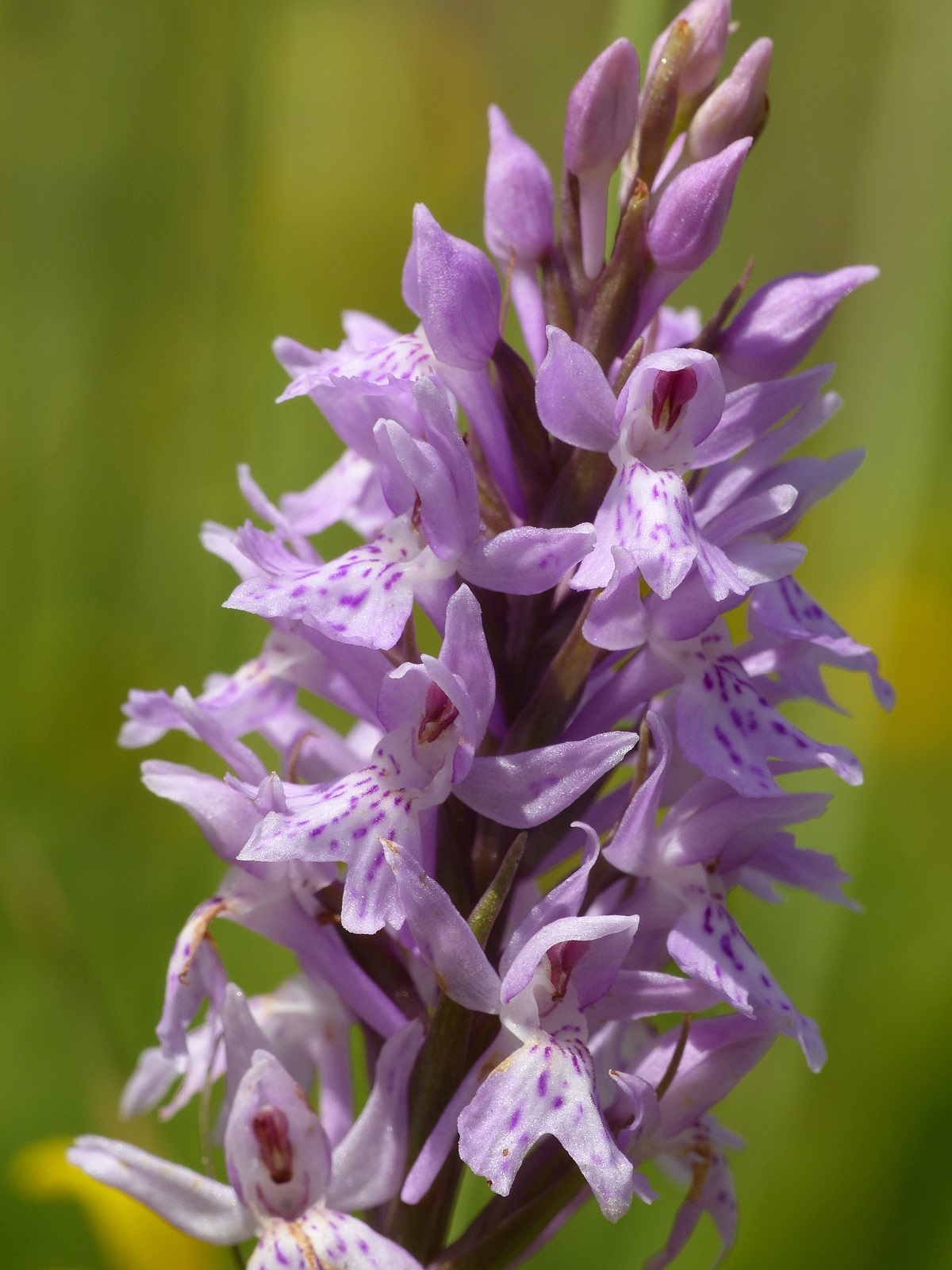
After an apparent absence of several years—though these things can be notoriously elusive!—Bee Ophrys apifera and Common Spotted-orchid Dactylorhiza fuchsii are coming into flower on Chapel Green. In previous years the best area for these orchids has been the southern edge of the meadow adjoining the road, the spot that is driest and has lowest fertility thanks to years of removal of hay. This year, the orchids are close to the pond margin in a much wetter, more fertile area (see photo) that we have been managing precisely to increase floral diversity. This morning there was one flowering spike of Bee and two of Common Spotted-orchid.
Ghost Moths Hepialus humuli are one of the few British moths that have entered popular culture and are—or used to be—generally known to the non-specialist. In earlier times, when insects were more abundant, meadows more commonplace, street lighting less widespread, and people abroad in the gloaming, an encounter with this species would have been a frequent early summer occurrence. Frequent but nevertheless remarkable. The memorable sight of a dozen or more large white moths hovering over the grass tops as if tethered to a thread in the fading light doubtless gave rise to their name.
Today this sight is considerably less familiar. In fact, unless they make a special effort, even moth-ers have rarely seen it. So when keen moth-man and wildlife writer James Lowenasked if anyone in East Anglia knew of a lek to cover in his forthcoming book, I racked my brains and suggested the two places that I had seen male moths in recent years: Old Buckenham village green and Chapel Green, Rocklands. This latter is a tiny plot of wildlife meadow that was restored by Rocklands Parish Council two decades ago through a Millenium Meadows grant, and financial support from Norfolk Rural Community Council, Norfolk County Council and guidance from Norfolk Wildlife Trust. It is a tiny (c. 0·015 ha) fragment of managed habitat that holds a surprisingly diverse and interesting flora and fauna, amongst which is a lek of Ghost Moths. I say lek, but when I checked back through my records I saw that I had only seen single males in June 2014, and (twice) in July 2016.
On D-Day, Thursday 6 June, despite a cool and windy evening, at 9.45 p.m.. I decided that I could no longer put off checking whether this year would produce an improvement on the singles that my memory had embellished into a weaving and bobbing troupe. I was fully prepared to tell James that the promised lek had not materialised and may have been unreliable in any case. What a relief to find two, then four, then finally a dozen male Ghost Moths "pendeculating" – Kettlewell's neologism for South's "swaying themselves to and fro without making progress".
The following evening, James was able to visit Chapel Green, arriving at 9.20 p.m. on his way back from another mothing assignment at Dungeness with moth expert Will Soar. For the first 20 minutes we enjoyed the meadow's wildflower display, twitching at passing Straw Dots Rivula sericealis and Common Swifts Korscheltellus lupulina (the latter a close relative of Ghost Moth) identified by Will. It was not until 9.40 p.m. that the first of our glowing white targets appeared, immediately followed by another, and another... Soon a group of six males were swaying and weaving on one side of the meadow, with another couple on the other. Our neighbour Carolyn, who coordinates the Chapel Green Management Committee, came out to enjoy the spectacle. We wondered if we might be lucky enough to see females, and shortly afterwards a dull yellowish brown female did indeed appear, immediately to mate with her chosen male. We found two pairs of mating moths, both on tall grass spikes, as well as a bloated female that was surely about to deposit her eggs. By 10.00 p.m. the display was over, and only these five Ghost Moths remained, clinging to their respective stems. The entire show had lasted exactly 20 minutes.
What is going on? A lek is an aggregation of male animals that come together, usually at a traditional site, to display together in order to compete for access to females. The phenomenon is especially well-documented in birds (particularly grouse and manakins) but not so widely-known in insects. In the case of Ghost Moths, the males hover over the grass, fanning their wings in order to release from scent brushes on the tarsus of the rear pair of legs a pheromone that attracts the females. The latter enter the lek briefly, select a mate, copulate on a grass stem and then fly off to drop their eggs over suitable grassy areas. The process was diligently observed and described by Mallet in his 1984 paper.
Formerly common, Ghost Moth is now a UK Biodiversity Action Plan
species, listed because its populations are declining markedly. Conservation of this and a suite of other disappearing
grassland plants and animals species is precisely the reason that Rocklands Parish
Council manage this small area as a wildflower meadow.
Kettlewell, H.B.D. (1973) The evolution of melanism. Clarendon Press: Oxford. 423 pp.
Mallet, J. (1984) Sex roles in the ghost moth Hepialus humuli (L.) and a review of mating in the Hepialidae (Lepidoptera). Zoological Journal of the Linnean Society80(1): 67–82. PDF.
South, R. (1908) The moths of the British Isles, second series. Frederick Warne & Co.: London. 388 pp.
Updates
James Lowen's wonderfully illustrated account of tonight's display here.
On the evening of 11 June, despite cool temperatures (10°C), moderate drizzle and a damp SE
2–3 breeze, we counted at least 14 males lekking for exactly 20 minutes 2149–2209. The females are more difficult to spot, but we did see two come in and mate with males.
The mild (15°C) evening of 17 June was even more active, with a high count for this year of at least 32 males and 4+ females between 2155 and 2215 (and perhaps later, as I left while it was still in full swing). A quick visit at 2210–2220 on the cool (14°C), evening of 22 June showed 24 males lekking, along with 1 female, though did not have time to check thoroughly.
Chapel Green in Rockland St. Peter has been a public watering hole since 1814 and there is a long history of active protection and management of the area for the use and enjoyment of the community. The green itself has been a meadow as far back as living memory can recall. Up until recent times, livestock have used the site for grazing. After a period of relative neglect—during which time rubble from neighbouring house developments was dumped, the green was used for car parking, sewage from an adjacent house drained directly onto the land, and the area was judged to be "in a rather parlous state"—towards the turn of the millennium, a dedicated Rockland Chapel Green Restoration Group acting on behalf of Rocklands Parish Council (RPC) sought recuperate the area. Millennium Meadow funding was obtained from Norfolk County Council (NCC), Norfolk Rural Community Council and RPC, and with advice from Norfolk Wildlife Trust and the NCC Countryside Officer, the community was able to clean the pond and restore the meadow.
As a result, for the past decade or two, the small (c. 0·015 ha) grassland has been managed as a wild-flower meadow by a succession of stewards appointed by the Parish Council, of which—since 2011—I am the incumbent. Management consists of an annual cut of hay in August–September, carried out by the Parish Council, followed by regular mowing during late summer through to early spring, effected by the steward or volunteers. During the spring and early summer, the meadow is left to flower and seed, ensuring the perpetuation of a rich diverse community of native flowers which support an impressive array of insect pollinators.
Up until 2012, the annual cut was carried out by the Bacon family on behalf of Parish Council, sometimes with help from various neighbours. The Bacons owned appropriate cutting apparatus and a lorry to remove the cuttings, which made light work of the operation. Since they left the village, it has proved more difficult to arrange the cut, and the task has fallen to a group of neighbours, who have struggled to arrange it. Harold Neale was particularly helpful in 2014 and 2015, sourcing a rotary scythe and performing the cut. In 2016, after not inconsiderable effort, and two promises of machinery, we failed to harvest the hay. This meant that the green looked lank and untidy for the best part of a year. Although the plants did flower as usual, the show was somewhat obscured by long grass. Fortunately, in 2017 our local Walnut Tree Garden Nursery offered us their brand new wheeled strimmer and we were able to effect the cut on 13 August as usual. The remaining stubble was mown to a short sward and the aftermath was cut by petrol mower during the last week of August. It is to be expected that the green will return to its usual state. We are also assured that the strimmer will be available in future. The group of neighbours that participated in this year’s cut is happy to continue to maintain the area in future if we can secure the appropriate equipment for the annual cut.
We have recently been made aware that several residents have been unhappy with the management of the green and would prefer to replace it with a frequently-mown short grass lawn. At the same time, one neighbour has asked that the green simply be cut once a year and the hay left to decompose, thus allowing the area to become a high-fertility meadow with a flora typical of our roadside verges. It is proposed that these ideas be discussed at the forthcoming Parish Council meeting.
If there is a proposal to change the management of the green, it would seem sensible that the community be made aware of its history, the considerable effort that the Parish Council has invested in turning it into a wild-flower meadow and its current ecological and social value to the village, so that we can make an informed democratic decision.
November 2017 update
RPC organised a community-wide vote on the future of Chapel Green with options being the continuation of the traditional management regime or conversion to a close-cropped lawn. The former option was overwhelmingly supported. RPC has created a Chapel Green Management Committee in order to carry out future management in accordance with the wishes of the Rocklands community.
Today villagers got together to carry out the annual cut of Chapel Green wild-flower meadow. Further posts on this wonderful local asset, managed by the community on behalf of Rocklands Parish Council, are to be found here.
The green had unfortunately grown quite long and rank, because we were unable to carry out the annual cut in 2016.
Thanks to the loan of a wheeled petrol strimmer by the kind people at the village's Walnut Tree Garden Nursery, we made short work of the cut.
Our late afternoon break, with the hay almost cut, consisted of Carolyn's locally harvested, home-made elderflower cordial, freshly harvested apple (from our garden) crumble, and tea.
After a further mow with the lawnmower, the green is ready for the coming year's growth.
Today we made our main annual cut of the Chapel Green
hay meadow in Rocklands. For the past several years, this small (c. 0·01
ha) recovered grassland has been managed as a wildflower meadow.
Since I was a boy, such meadows have all but disappeared from the
United Kingdom, many of them being ploughed up, converted to pasture
or built on; in all, 97% of our meadows have been lost since World
War II and it is now our most endangered type of vegetation. As in
many other matters, Rocklands has bucked the trend and our modest
patch of flower-rich grassland has been improving in quality even in
the short five years that we have lived here. Chapel Green is an
asset of which the village can be justifiably proud.
♂ Common Blue Polyommatus icarus
Traditional meadows grow on soils which have been
impoverished by many years of grazing, which constantly removes
nutrients from the soil. A regime of late-summer cutting, just after
the flowers have set seed, and subsequent removal of the hay keeps
nutrients low and enables the more interesting and less widespread
plants to flourish. From the nodding heads of Cowslips Primula
veris that herald the spring, through the June carpet of yellow
Bird's-foot Trefoil Lotus corniculatus and Yellow Rattle
Rhinanthus minor to late summer Meadowsweet Filipendula
ulmaria, there is always something in bloom. The purple spikes of
Knapweed Centaurea nigra and yellow discs of Fleabane
Pulicaria dysenterica attract butterflies which add to the
palette: we have over a dozen species, and resident colonies of Essex
Skipper Thymelicus lineola, Common Blue Polyommatus icarus
and gaudy Six-spot Burnet Zygaena filipendulae moths.
A careful observer might find the curious Bee Orchid Ophrys apifera
– no longer a common plant and seven of which flowered in 2014 – or
Common Spotted-orchid Dactylorhiza fuchsii, the first spike of
which appeared this summer. In all, the green is home to fifty
species of flowering plants. Insects and seeds attract the birds, and
Swallows and Swifts skim over the grass, Goldfinches worry the
seedheads and owls hope for a vole – Barn, Tawny and Little Owls
all visit. The population of Field Voles reaches such levels that on
the 2013 cut the fleeing mammals were almost biblical in proportions.
Chapel Green's pond is home to Great Crested Newts Triturus
cristatus, Grass Snakes Natrix natrix and several types of
dragonfly. Kingfishers check in from time to time; our first,
bitterly cold winter a Snipe huddled in our drainage ditch, while
last year a Sedge Warbler established its territory in the tall Great
Willowherb Epilobium hirsutum and Reedmace Typha latifolia
at the water margin.
After the cut, we will wait
for the aftermath to emerge, close-cut perhaps two or three times more
and then let the meadow settle down for the winter. All we need to
maintain this rich and diverse meadow is to continue the regime of
late-summer cuts, remove the resulting hay, and ensure that cars do
not park on the area in winter; nature will do the rest. Let's enjoy
this wonderful asset to our village.
Finest quality hay, waiting to be bagged and removed
The most favourable day for insects so far this year: a mostly sunny morning, with temperatures pulling above 22°C by midday. Over the last weeks or so, Six-spot BurnetZygaena filipendulae caterpillars have been leaving off feeding on the Bird's Foot Trefoil Lotus corniculatus to climb up the stems of taller grasses to pupate. Today there were several caterpillars, three pupae and the first adult of the year.
The Common Knapweed Centaurea nigra has just come into flower and, in addition to the burnets, there were single of several species of butterfly: Essex Skipper Thymelicus lineola, Large Skipper Ochlodes sylvanus, Meadow Brown Maniola jurtina and Small Tortoishell Aglais urticae.
Large Skipper Ochlodes sylvanus
After seven spikes in 2014, the Bee Orchids are absent this year. However, a Common Spotted Orchid Dactylorhiza fuchsii - a new species for the green - compensates.
I managed to overlook this plant when it was flowering but, thanks to Margaret Neale who runs the village's wonderful Rylstone B&B, I did eventually track down this fruiting Bee Orchid Ophrys apiferaon Chapel Green next to our house.
Harold Neale's photograph of the same plant, taken when they found it 17 days earlier on 9th July, is a bit more impressive...
The presence of this species on our tiny plot of meadowland is a good indicator of the importance for conservation of even these small areas of appropriately-managed grassland.