Showing posts with label bats. Show all posts
Showing posts with label bats. Show all posts
Sunday, 1 September 2013
Norfolk Bat Survey concluded
I just retrieved the BTO's recording equipment from the final point I had signed up to survey for the Norfolk Bat Survey. I would have like to have covered a couple of extra grid squares, but have been unable to get permission to locate the equipment overnight. Nevertheless, in a little over a month I have managed to cover nine O. S. grid squares in the Rocklands area - that's 27 detector-nights, each at a different location no closer than 200 m to its closest neighbour. This should give a fair idea of the variety of bats we are lucky enough to share this area with. Looking forward to receiving the final results from the BTO...

Friday, 30 August 2013
Norfolk Bat Survey at Rocklands: Goose Common
The BTO kindly sent me the results of three further O.S. grid squares today.
On the nights of 11, 15 and 21 August, the detector was set in and around Goose Common. This was habitat for Common and Soprano Pipistrelles, and Brown Long-eared Bat. In addition Natterer's and Serotine were recorded along a grassy ride between patches of oak-hawthorn wood. The garden of nearby clay-lump cottage produced a large number of recordings of Common Pipistrelle, suggesting a roost.
On the nights of 11, 15 and 21 August, the detector was set in and around Goose Common. This was habitat for Common and Soprano Pipistrelles, and Brown Long-eared Bat. In addition Natterer's and Serotine were recorded along a grassy ride between patches of oak-hawthorn wood. The garden of nearby clay-lump cottage produced a large number of recordings of Common Pipistrelle, suggesting a roost.
Wednesday, 7 August 2013
Norfolk Bat Survey at Rocklands: 2nd O. S. grid square
The BTO are very quick and efficient in analysing the data generated through the Norfolk Bat Survey and I have just received the results of the second O. S. grid square that I covered.
On 2 August, the detector at my own house recorded just Common and Soprano Pipistrelles. At least this confirms the identity of the bats that roost in the shed at the bottom of the garden and hawk around the trees at dusk.
The following night, the same species, together with Brown Long-eared Bat were found at Walnut Tree Garden Nursery. Daubenton's bat may have been recorded as well.
The best night was 4 August, when the detector was set between two tall hedgerows close to a pond on the W side of Green Lane, at the end of Flymoor Lane. This was habitat for Natterer's, Noctule, Soprano and Common Pipistrelles. In addition, Daubentons, Leisler's, Serotine and Whiskered Bats were registered with low confidence. This just goes to show how a small amount of good habitat - simply tall hedgerows and a pond - can ensure that wildlife survives even in an otherwise barren agricultural wasteland.
On 2 August, the detector at my own house recorded just Common and Soprano Pipistrelles. At least this confirms the identity of the bats that roost in the shed at the bottom of the garden and hawk around the trees at dusk.
The following night, the same species, together with Brown Long-eared Bat were found at Walnut Tree Garden Nursery. Daubenton's bat may have been recorded as well.
The best night was 4 August, when the detector was set between two tall hedgerows close to a pond on the W side of Green Lane, at the end of Flymoor Lane. This was habitat for Natterer's, Noctule, Soprano and Common Pipistrelles. In addition, Daubentons, Leisler's, Serotine and Whiskered Bats were registered with low confidence. This just goes to show how a small amount of good habitat - simply tall hedgerows and a pond - can ensure that wildlife survives even in an otherwise barren agricultural wasteland.
Wednesday, 31 July 2013
Norfolk Bat Survey at Rocklands: exciting first results!
To my surprise, the BTO have already processed the data from the first O. S. grid square that I collected as part of their Norfolk Bat Survey. They sent me an interesting resumé, the highlights of which appear below.
On the inaugural night of 25 July the recorder was located in a garden by an old clay-lump cottage along Green Lane. All three pipistrelles were recorded including the scarcest, Nathusius' Pipistrelle. There have been fewer than 850 British records of this bat (fide http://www.nathusius.org.uk) which was first reorded in Norfolk just 15 years ago; it's known UK distribution is plotted here (copied below).
Another uncommon bat, Serotine, was the fourth species. In the UK, it occurs south of a line from Cornwall to The Wash and classically roosts in old buildings, often churches. Its populations are declining.
The following evening, St. Peter's Church produced six confirmed species of bat. The Barbastelle was the highlight. Its UK population is estimated to be c. 5000 and decreasing, and it is considered Near Threatened internationally.
Serotine was present once again. The other species were Noctule, Common and Soprano Pipistrelles and Brown Long-eared Bat. Nathusius' Pipistrelle may have been recorded too.
A complex of old clay-lump barns and outbuildings next door to the church, which used to hold good numbers of bats, are in the process of renovation. Hopefully, mitigation measures have been taken to ensure that the bats are able to find new roost sites.
On the inaugural night of 25 July the recorder was located in a garden by an old clay-lump cottage along Green Lane. All three pipistrelles were recorded including the scarcest, Nathusius' Pipistrelle. There have been fewer than 850 British records of this bat (fide http://www.nathusius.org.uk) which was first reorded in Norfolk just 15 years ago; it's known UK distribution is plotted here (copied below).
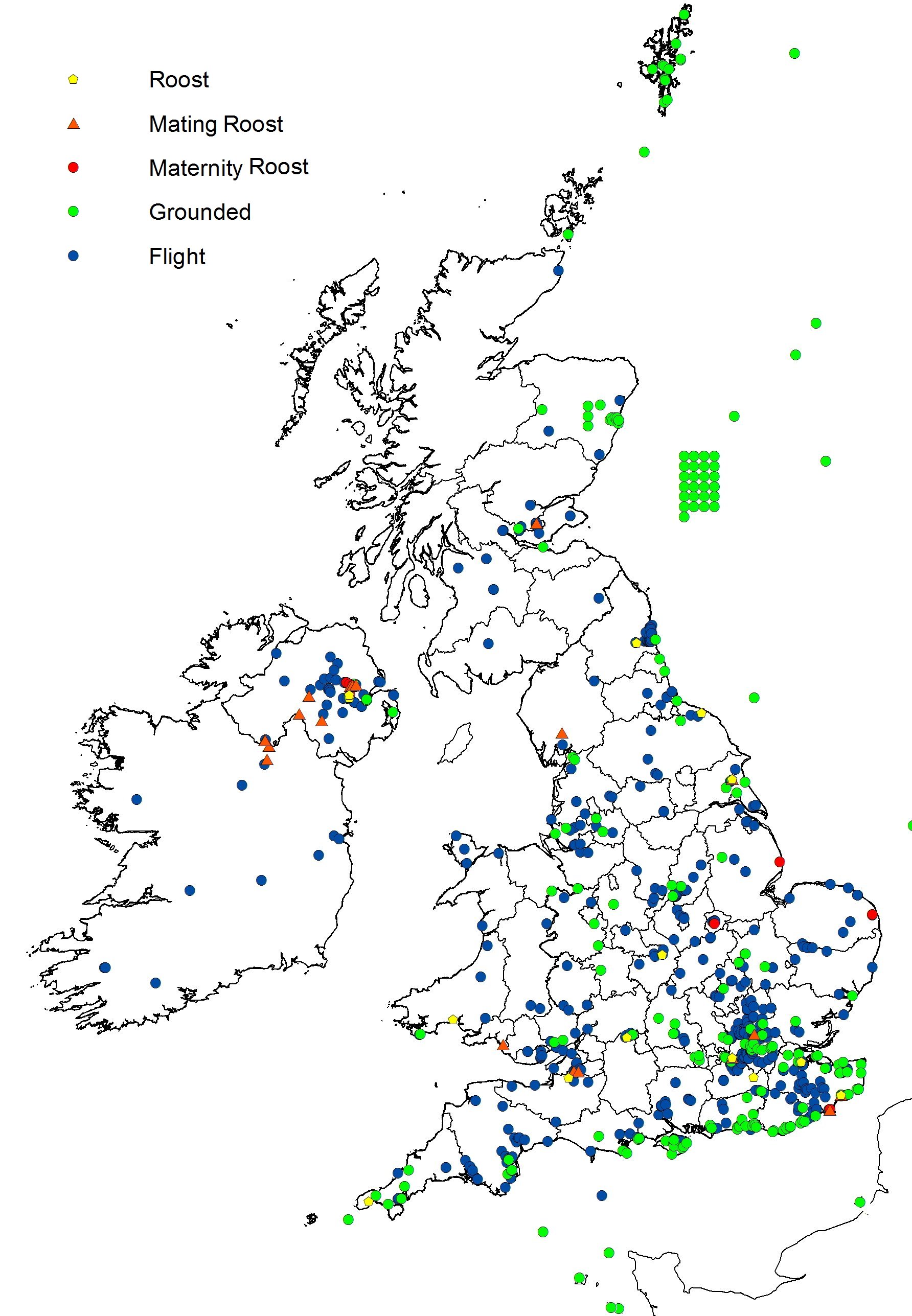 |
| All known UK records of Nathusius' Pipistrelle Pipistrellus nathusi (source: http://www.nathusius.org.uk/Distribution.htm) |
The following evening, St. Peter's Church produced six confirmed species of bat. The Barbastelle was the highlight. Its UK population is estimated to be c. 5000 and decreasing, and it is considered Near Threatened internationally.
 |
| Barbastelle Barbastella barbastellus UK distribution (source: http://jncc.defra.gov.uk/publications/jncc312/species.asp?FeatureIntCode=S1308) |
Serotine was present once again. The other species were Noctule, Common and Soprano Pipistrelles and Brown Long-eared Bat. Nathusius' Pipistrelle may have been recorded too.
 |
| Bat detector @ St Peter's Church, Rocklands |
Subscribe to:
Comments (Atom)