Wednesday, 13 August 2014

Neotropical Birding 15 is out!

Back from a few days' camping in the Yorkshire Dales to find copies of Neotropical Birding 15 on my doormat, fresh from the printers...


Welcome to issue 15 of Neotropical Birding!


The Autumn 2014 issue of Neotropical Birding, NB15, has just been published. This issue commemorates the life of Alexandre Renaudier, the young French ornithologist who died prematurely last year. Alex was a very keen birder, who spent most of his time in the field and made some extraordinary ornithological discoveries. He had a sensitive ear, testimony to which is the wonderful collection of recordings he co-authored: Bird Voices from French Guiana. He had a close relationship with NBC, acting as Country Representative for France and French Guiana between 2006 and 2013.

Appropriately, our cover story presents the first photographs of the enigmatic Rusty Tinamou Crypturellus brevirostris from Alex's adopted home, French Guiana – truly Birding at the cutting edge.

Our first Photospot provides further ground-breaking images from the same country, this time of nesting Black-bellied Cuckoo Piaya melanogaster, while the second piece is dedicated to another mysterious species, Giant Snipe Gallinago undulata.

Alex rarely found the desk-time necessary to publish his findings, but in our Identification Workshop, he and his friend Olivier Claessens reprise Field identification of Least and Yellow-billed Terns, a subject explored by Floyd Hayes in Cotinga in 2001. Further advances have made this challenge a lot easier and should result in better reporting in the future.

Switching environments somewhat, the American Bird Conservancy's Dan Lebbin takes us back to northern Peru, in a sequel to his Nightbirds article published in NB11. Dan returns in the daytime, with some suggestions for tracking down 50 species of hummingbird. A Hummingbird Paradise, perhaps?

No issue of Neotropical Birding is complete without an invitation from Alex Lees to “get your lists out” for another roller-coaster ride through the world of avian taxonomy and systematics in Splits, lumps and shuffles (one of Alex Renaudier's favourite columns).

Our compilation of recent published and unpublished records, Neotropical Notebook, is compiled by Guy Kirwan and his team of collaborators: Dušan Brinkhuizen, Diego Calderón, Bradley Davis, Jeremy Minns and Kini Roesler.

NBC has always played a role in conserving Neotropical Birds. Jez Bird tells us about this year's award winners and the continuing benefits of projects financed in the past in NBC Conservation Awards Update. Your contribution to NBC helps Award recipients give something back to the Neotropical birds we all enjoy.

We round off the issue with Book reviews of two of last year's most exciting publications: Birdwatching in Colombia and Birds and People.


Happy Neotropical birding!

Christopher J. Sharpe, Senior Editor


Neotropical Birding 15: contents


Sharpe, C. J. (2014) Welcome to issue 14 of Neotropical Birding. Neotrop. Birding 15: 2.

Ingels, J., Claessens, O. & de Pracontal, N. (2014) Neotropical Birding 15: a tribute to Alexandre Renaudier. Neotrop. Birding 15: 3. E-mail: johan.ingels@skynet.be

Lees, A. C. (2014) Splits, lumps and shuffles. Neotrop. Birding 15: 4–14. [resume of recent publications on taxonomy and systematics concerning multiple taxa] E-mail: alexanderlees@btopenworld.com

Rufray, V., Pelletier, V. & Ingels, J. (2014) First photographs and new records of the Rusty Tinamou Crypturellus brevirostris from French Guiana. Neotrop. Birding 15: 15–19. [Crypturellus brevirostris] E-mail: vrufray@biotope.fr / johan.ingels@skynet.be

Claessens, O. &  Renaudier, A. (2014) Field identification of Least and Yellow-billed Terns: experience from French Guiana. Neotrop. Birding 15: 22–31. [Sternula superciliaris, Sternula antillarum] E-mail: olivier.claessens@gepog.org

Lebbin, D., Aucca Chutas, C., Olmos, F. & Spencer, A. (2014) Hummingbird paradise: northern Peru. Neotrop. Birding 15: 33–41. [multiple Trochilidae spp. of N Perú] E-mail: dlebbin@abcbirds.org

Kirwan, G. M., Brinkhuizen, D., Calderón, D., Davis, B., Minns, J. & Roesler, I. (2014) Neotropical Notebook: published and unpublished records. Neotrop. Birding 15: 46–62. [resume of recent records concerning multiple taxa] E-mail: gmkirwan@aol.com

Ingels, J. & Fernandez, M. (2014) Photospot: A nest of Black-bellied Cuckoo Piaya melanogaster in French Guiana. Neotrop. Birding 15: 63–65. [Piaya melanogaster] E-mail: johan.ingels@skynet.be

Smith, P., Bland, D. & Clay, R. (2014) Photospot: Waka Waka: The Giant Snipe Gallinago undulata in Paraguay. Neotrop. Birding 15: 66–69. [Gallinago undulata] E-mail: faunaparaguay@gmail.com

Bird, J. (2014) NBC Conservation Awards update. Neotrop. Birding 15: 71–75. [Glaucidium nubicola, Megascops colombianus, Coeligena orina, Henicorhina negreti, Dacnis hartlaubi, Compsospiza garleppi] E-mail: jezbird@gmail.com

Morris, P. (2014) Book review: Birdwatching in Colombia. Neotrop. Birding 15: 78–79. E-mail: pete.morris@virgin.net

Sharpe, C. J. (2014) Book review: Birds and people. Neotrop. Birding 15: 79–80. E-mail: neotropical.birding@neotropicalbirdclub.org

Wednesday, 6 August 2014

Book review: Woodpeckers of the World by Gerard Gorman

Woodpeckers of the World

Gerard Gorman
Christopher Helm | 2014
528 pp. | 17 x 24 cm | 722 colour photographs. 239 maps Hardback | £35 / $49.95 | ISBN: 978-1-4081-4715-3


Gerard Gorman is a woodpecker nut. I know because I have been privileged enough to have spent a couple of weeks with him in the field, sharing part of his quest for the world's woodpeckers. Our field trip took place in 2009 and began when we met in an aeroplane on the way to Guyana. As owners of bird tour companies, we had both been invited to travel to Guyana on a 'fam' trip. We met on the London – Port-of-Spain leg and, since we had been assigned adjacent seats, spent much of the ten hour flight talking about birds. Needless to say, I learned a lot about the Picidae! The trip came out of the blue for me and I had been unable to return home to load my collection of bird vocalisations onto my iPod, but Gerard assured me that he had everything that we would need. Some time into the flight I asked to borrow his iPod. When I scrolled through the species list, I found only woodpeckers... Throughout our Guyana trip, Gerard would always home in on a woodpecker, even to the point of shunning some of the Neotropics' most charismatic species. Since then I have regarded this often-overlooked family in a new light and with renewed interest. So who better to guide us through the world of woodpeckers?

This is a major new overview of the world's woodpeckers by an expert on the subject who has two previous woodpecker publications under his belt: Woodpeckers of Europe and The Black Woodpecker. Woodpecker taxonomy is a subject for debate, but for the purposes of this book the author recognises 239 species. Each receives a detailed text with information on identification, vocalisations, food, conservation status, habitat, range and notes on taxonomy and similar species. Interestingly, for the first time, the author specifically includes information on drumming – or absence of it. Each species account is accompanied by a range map and typically several photographs illustrating sexual dimorphism or subspecific variation.

As one would expect, the text has been exhaustively researched and carefully compiled from a broad range of primary sources, but the author himself has travelled widely to gain extra field experience with a large number of species. So this is more than a literature review; it is a real contribution to our knowledge of woodpeckers. As the author recognises: “During my research it soon became clear that many species of woodpecker are poorly-known, with questions on taxonomy, biology, behaviour, distribution and even existence remaining unanswered.” One of the contributions of this book is to point out areas that require further research.

Good as the text is, the photographs are surely going to be the main reason for purchasing this book. There are, on average, three images per species and the quality is generally excellent. My favourites are the Piculus, the photographs capturing the striking plumage and eye colour that often receive rather drab treatment in field guides. I have to mention the wonderful sequence of the interior of a Downy Woodpecker nest, showing the development of the young.

Maps need some checking. For example, of the Neotropical woodpeckers I checked, Ivory-billed Woodpecker Campephilus principalis is shown on Hispaniola rather than Cuba; the Trinidadian range of Chestnut Woodpecker Celeus elegans is not shown, whereas Red-crowned Melanerpes rubricapillus is erroneously shown on Trinidad (it is found on Tobago); the Belizean range of Acorn Woodpecker Melanerpes formicivorus is not depicted; Cinnamon Woodpecker Celeus loricatus is shown for W Venezuela, although it does not occur in the country; and the NE Venezuela range of Golden-spangled Piculet Picumnus exilis is absent.

For those who already have Winkler et al.'s 1995 Pica Press Woodpeckers of the World (and / or HBW 7, published in 2002), is there enough novel content to justify buying this new book? The answer is yes. The text updates Winkler et al. and an extensive bibliography of post-2002 publications is provided (current enough to include, for example, del Rio et al.'s 2013 six-way split of the 'Golden-green' Woodpecker Piculus 'chrysochloros' complex). The photographs provide a useful complement to both Winkler et al. and HBW 7. For example, the distinctly larger bill of White-bellied Piculet Picumnus spilogaster compared with other similar species is clearly shown – something that I have not seen in field guide illustrations.

In short, a really nice reference book to an attractive and often under-rated group of birds. This will surely set the record straight. Excellent work Gerard!


References

del Hoyo, J., Elliott, A. & Sargatal, J. (2002) Handbook of the birds of the world. Vol. 7: jacamars to woodpeckers. Lynx Edicions: Barcelona. 613 pp.

Gorman, G. (2004) Woodpeckers of Europe: a study of the European Picidae. Bruce Coleman: London. 192 pp.

Gorman, G. (2011) The Black Woodpecker: a monograph on Dryocopus martius. Lynx Edicions: Barcelona. 184 pp.

Winkler, H., Christie, D. A. & Nurney, D. (1995) Woodpeckers: a guide to the woodpeckers, piculets and wrynecks of the world. A & C Black: London. 416 pp.

Friday, 25 July 2014

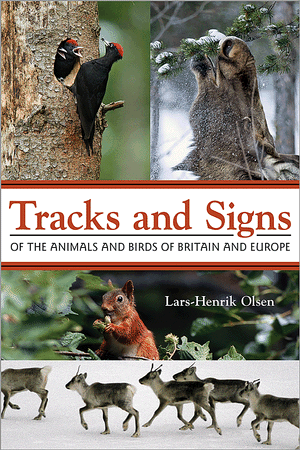
Book review: Tracks and Signs of the Animals and Birds of Britain and Europe by Lars-Henrik Olsen

Tracks and Signs of the Animals and Birds of Britain and Europe

Lars-Henrik Olsen
Princeton University Press | 2013
272 pp. | 16 x 23.5 cm | 600 colour illustrations & photographs. 25 maps
Paperback flexibound | £17.95 / $29.95 | ISBN: 9780691157535

This is a very well produced, abundantly illustrated guide to the tracks and signs of 175 species of European mammals and birds, bound in a field-friendly, flexible cover. The first hundred pages are thematic sections on bird and mammal tracks, scat, feeding signs, nests and dens, pellets and feathers, while the remainder of the book comprises species accounts for mammals. The first part of the book is the most useful in identification since, for example, different types of owl pellet and comparative illustrations of footprints are presented in the same place.

The only guide to tracks and signs I have on my shelves is the Collins Guide (Bang & Dahlstrom 1974), acquired in the late 1970s. Surprisingly, this (in a 2001 2nd edition) and the Hamlyn Guide (Brown et al. 1992) have remained the standard European field guides, despite their age. How does Olsen's guide measure up? Over the period of a few months last autumn, I made an effort to consult Bang & Dahlstrom and Olsen on every track, trail or sign I encountered.

The first test was a badger sett and obvious runs on nearby farmland. Bang & Dahlstrom cover this well, with a good description, clearly differentiating it from a fox's earth, and photos (monochrome in the original, colour in the newer edition). Olsen goes a little further, with a lot more text and images of bedding, as well as the quintessential sett.

Cutting the hay on our village green in August revealed a network of Field Vole runs. These are well depicted in my Bang & Dahlstrom, replaced by a colour photograph of winter runs in the newer edition, similar to the one used in Olsen.

Next a Goldfinch feather – easy enough to identify without a guide. None of the guides included it. Olsen has four pages dedicated to feathers of a dozen species, but not this one. He does, however, provide a lovely photograph that shows just how the Waxwing got its name.

Our garden is full of Bank Voles and Wood Mice, but which of them has been at the Hazel cobs? According to Bang & Dahlstrom, who provide excellent comparative illustrations, this neat round hole that looks to have been made by a mini tin-opener was the work of the Wood Mouse. Confusingly, Olsen has strikingly similar paintings, but with different incisor marks to illustrate the work of the Bank Vole.

Goshawk-killed Woodpigeon, Norfolk, December 2013
Over winter I encountered several Goshawk kills, all Woodpigeons, but scattered throughout the pair´s territory. Bang & Dahlstrom include a photograph that might have been taken of one of the kills I found; this is substituted with a Mallard in the 2001 edition. Olsen has a photograph of a Goshawk astride a mass of black feathers – the remains of a Coot – which is probably not as helpful.

By springtime, the first crocuses were attracting the attention of House Sparrows. All credit to Bang & Dahlstrom for including a colour photograph that captures this perfectly. Oddly, this seems to have disappeared from the newer edition, nor does Olsen mention this behaviour.

To be fair, the old Collins and Hamlyn books are true field guides – compact, portable and laid out for field reference – whereas Olsen is more of an introduction to tracks and signs for home use. Including, as it does, plenty of photographs of the animals that make tracks, as well as distribution maps, it will be particularly useful for those who do not already have a field guide to mammals. Over half the book is dedicated to species accounts of this sort rather than comparative analysis of tracks; arguably, in an identification guide, this space could have been better used for tracks themselves. This is a book aimed more at a European then a UK readership, with eight pages devoted to Red Squirrels and just one to Grey, and the inclusion of large carnivores like Lynx, Wolf and Bear, as well as ungulates like Moose and Musk Ox.

Nevertheless, there is much to enjoy here, from the new illustrations to the excellent photographs. A useful addition to the literature on tracks and signs, which adds to the previously available guides. Sadly, we still do not have a European reference equivalent of Mark Elbroch's superb Mammal tracks and signs: a guide to North American species.
 

References

Bang, P. & Dahlstrom, P. (1974) Animal tracks and signs. Collins: London. 240 pp.

Bang, P. & Dahlstrom, P. (2001) Animal tracks and signs. Oxford University Press: Oxford. 264 pp.

Brown, R.W., Lawrence, M.J., & Pope, J. (1992) Animal tracks, trails and signs. Hamlyn: London. 320 pp.

Elbroch, M. (2003) Mammal tracks and signs: a guide to North American species. Stackpole Books: Mechanicsburg, PA. 780 pp. 

Sunday, 13 July 2014

What do the scientific names of birds mean?

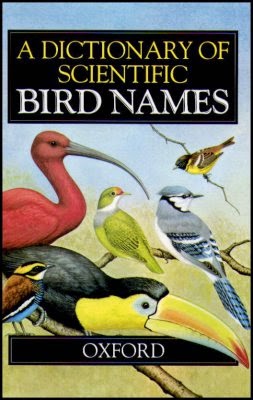
I have always found it easy to remember the scientific names of the birds and other organisms with which I work. In fact, for groups like fungi, insects and Neotropical birds, I find it easier to memorise a scientific name than to try to recall the often inappropriate English name that the species in question happens to be called in one place or another throughout its range. I think this preference for scientific names comes down to at least a rudimentary understanding of their meaning. Admittedly, I am the kind of person who likes to read a field guide or a dictionary, as many people read a novel. The Compact Oxford English dictionary is one of my favourite reads, albeit with the aid of a magnifying glass these days. So, naturally, I love James Jobling's A dictionary of scientific bird names. My particular copy was a gift from two fanatical world birders, Mark Sokol and Lanie Langlois, the sort of people who spend their Californian winter weekends and evenings researching the minutiae of avian systematics and taxonomy in order to better understand which taxa – potential species – they need to see on their next trip. At the time Jobling was extraordinarily difficult to find and was rather pricey, so I am eternally grateful to have received the book. A decade later, I suspect that I have had their money's worth: this is a book that I consult constantly and read for pleasure as well.

While I have been using HBW Alive over the last few months, I have noticed that as my mouse passes over a bird name, a box pops up with a surprising amount of etymological information. I have come to spend some time exploring this. I've always had a soft spot for Xiphocolaptes promeropirhynchus ("Sugarbird-billed Swordpecker"), the rhythm of the scientific name being almost poetic, its heft matching that of the bird – which is perhaps better known as Strong-billed Woodcreeper.

Only now have I found out that the person responsible is the very same James Jobling. Apart from adding this information to the species accounts, he has produced a Key to Scientific Names in Ornithology, which enables the user to determine the meaning of any scientific name, together with a fascinating introduction to the subject. So, if you have ever wondered what a bird's name means, look no further than this wonderful on-line resource. More information is to be found here.


References

Jobling, J.A. (1991) A dictionary of scientific bird names. Oxford University Press: Oxford. 272 pp.

Book review: Wildlife of the Caribbean by Herb Raffaele and Jim Wiley

Wildlife of the Caribbean

Herbert A. Raffaele & James W. Wiley
Princeton University Press | 2014
304 pp. | 12.8 x 29.3 cm | 600 colour illustrations. 1 map Paperback | £13.95 / $19.95 | ISBN: 9780691153827

The Caribbean is a popular destination for travellers and, as well as its signature beaches, it harbours a diverse and distinctive fauna and flora, with a large number of island endemics. Up until now there has been a lack of a field guide to enable the curious visitor to readily identify what he/she encounters. Sure enough, there are several slim photographic brochures covering different aspects of the natural world, and the wonderful old Riley field guide to butterflies, but the only really good modern resource is the comprehensive Birds of the West Indies (not to be confused with James Bond's pioneering book of the same name). Two of the authors of that guide, Herb Raffaele and Jim Wiley, have teamed up to fill the gap with this handy little pocket guide which aims to cover pretty much anything the casual visitor might encounter, from conspicuous plants to reef fish and seashells. The book is “intended to serve as a practical guide for local people and tourists alike” and the authors “presume its users have no particular experience or expertise with nature”.

The book is small and light enough to fit into a large pocket, pouch or handbag, so it can be taken almost anywhere. It is very well organised and carefully laid out, with text opposite or next to plates, so there is no need to flip back and forth to find a description. The book is split into two sections: terrestrial and marine. Chapters on terrestrial wildlife deal with plants, mammals, birds, reptiles, amphibians, freshwater fish and invertebrates. The marine section covers whales and manatee, sea turtles, reef fish and marine invertebrates, including shells. So, whether in the mountains, on the beach, or snorkelling, this guide should be of service. The 451 commonest and most widespread species have been chosen, leaving out a large number of organisms that are rarely encountered. Most of the illustrations are paintings by several different artists, but plants and invertebrates are depicted with photographs. Given the track record of the authors, each with over 40 years' experience in the Caribbean, the user can be sure that the text is authoritative.

A 300+ page, full-colour guide written by experts, priced at £14 (and quite a lot cheaper on-line) is a real bargain. This handy guide will be welcomed by residents, casual holiday-makers and wildlife enthusiasts alike.


References

Bond, J. (1936) Birds of the West Indies. Academy of Natural Sciences: Philadelphia, PA. 456 pp.

Raffaele, H., Wiley, J., Garrido, O., Keith, A. & Raffaele, J. (1998) Birds of the West Indies. Princeton University Press: Princeton NJ. 511 pp.

Raffaele, H., Wiley, J., Garrido, O., Keith, A. & Raffaele, J. (2003) Birds of the West Indies. Princeton University Press: Princeton NJ. 216 pp.

Riley, N.D. (1975) Field guide to the butterflies of the West Indies. Collins: London. 224 pp.

Friday, 4 July 2014

Norfolk moths: Rockland St. Peter garden, 3 July 2014 ('Moth Night 2014')

Organised by Atropos and Butterfly Conservation, Moth Night is the annual celebration of moth recording throughout Britain and Ireland by enthusiasts, with local events aimed at raising awareness of moths among the general public. This year the organisers are inviting moth enthusiasts to record the moths they observe on any one or more of the days or nights 3rd5th July. Having checked the weather forecast, Thursday 3rd July looked to be the best night of the three. Sure enough, this short night the trap was on for six and a half hours produced a record-breaking catch.
 
After a glorious warm, sunny day, skies remained clear for most of the night, with temperatures of 17.7°C at 23h30 and 12.3°C when I turned off the MV light at 04h15. A moderate SW during the day calmed by evening. The first quarter moon was barely noticeable. Blackbirds
 
Four species of hawk-moths, of which Pine Hawk-moth was new. Peppered Moths came in two flavours: one each of the normal light form and f. carbonaria. Local species included a lovely, fresh Dwarf Cream Wave, 3 Large Twin-spot Carpets, my second Wood Carpet, a Lilac Beauty, Sycamore, another Miller, Dingy Shears, a striking Scarce Silver-lines and 7 Beautiful Hook-tips. Of conservation concern was a Cream-bordered Green Pea which is Nationally Scarce B (species occurring nationally in 31100 hectads).

Large Twin-spot Carpet Xanthorhoe quadrifasiata
Wood Carpet Epirrhoe rivata
Lilac Beauty Apeira syringaria
Pine Hawk-moth Hyloicus pinastri
Sycamore Acronicta aceris
Dingy Shears Parastichtis ypsillon
Scarce Silver-lines Bena bicolorana


Macro-moths (198 moths of 62 spp.):-

Cilix glaucata Chinese Character 1
Habrosyne pyritoides Buff Arches 3
Geometra papilionaria Large Emerald 1
Timandra comae Blood-vein 1
Idaea fuscovenosa Dwarf Cream Wave 1
Idaea dimidiata Single-dotted Wave 3
Idaea aversata Riband Wave 7
Xanthorhoe quadrifasiata Large Twin-spot Carpet 3
Epirrhoe rivata Wood Carpet 1
Camptogramma bilineata Yellow Shell 1
Eulithis pyraliata Barred Straw 1
Perizoma alchemillata Small Rivulet 1
Pasiphila rectangulata Green Pug 4
Lomaspilis marginata Clouded Border 7
Opisthograptis luteolata Brimstone Moth 6
Apeira syringaria Lilac Beauty 1
Crocallis elinguaria Scalloped Oak 1
Ourapteryx sambucaria Swallow-tailed Moth 2
Biston betularia Peppered Moth 2
Ectropis bistortata Engrailed 2
Cabera pusaria Common White Wave 1
Cabera exanthemata Common Wave 2
Lomographa temerata Clouded Silver 4
Sphinx ligustri Privet Hawk-moth 1
Hyloicus pinastri Pine Hawk-moth 1
Laothoe populi Poplar Hawk-moth 1
Deilephila elpenor Elephant Hawk-moth 4
Phalera bucephala Buff-tip 4
Pheosia tremula Swallow Prominent 1
Pterostoma palpina Pale Prominent 2
Eilema lurideola Common Footman 27
Spilosoma luteum Buff Ermine 9
Agrotis exclamationis Heart and Dart 4
Axylia putris Flame 1
Ochropleura plecta Flame Shoulder 1
Noctua pronuba Large Yellow Underwing 4
Xestia triangulum Double Square-spot 11
Discestra trifolii Nutmeg 1
Melanchra persicariae Dot Moth 2
Lacanobia oleracea Bright-line Brown-eye 6
Mythimna conigera Brown-line Bright Eye 4
Mythimna ferrago Clay 4
Mythimna impura Smoky Wainscot 8
Acronicta aceris Sycamore 1
Acronicta leporina Miller 1
Amphipyra pyramidea agg. Copper Underwing agg. 1
Parastichtis ypsillon Dingy Shears 1
Apamea monoglypha Dark Arches 2
Apamea lithoxylaea Light Arches 5
Oligia strigilis agg. Marbled Minor agg. 1
Hoplodrina alsines Uncertain 7
Paradrina clavipalpis Pale Mottled Willow 2
Earias clorana Cream-bordered Green Pea 1
Bena bicolorana Scarce Silver-lines 1
Diachrysia chrysitis Burnished Brass 1
Autographa jota Plain Golden Y 1
Abrostola tripartita Spectacle 1
Laspeyria flexula Beautiful Hook-tip 7
Rivula sericealis Straw Dot 1
Hypena proboscidalis Snout 3
Zanclognatha tarsipennalis Fan-foot 8
Herminia grisealis Small Fan-foot 1


Micro-moths (23 moths identified, of 5 spp.):-

Eurrhypara hortulata Small Magpie 11
Phlyctaenia coronata
1
Pleuroptya ruralis Mother of Pearl 7
Aphomia sociella Bee Moth 3
Pterophorus pentadactyla White Plume Moth 1


Saturday, 21 June 2014

Norfolk moths: Rockland St. Peter garden, 20 June 2014

It might have been about the shortest night of the year, with the trap only on for six hours or so, but it yielded the best catch I have had from this Skinner trap. After a warm, sunny day, skies remained clear for most of the night, with temperatures of 13.2°C at 22h30 and 10.0°C when I turned off the MV light at 04h00. Calm, with the hint of a light S air. A last quarter moon, with the new moon a week off.

There was still almost no activity by 23h00. The trap was almost dead, except for a Aphomia sociella Bee Moth on the wall alongside. I had painted a bit of sugar around the garden, but only a few Marbled Minor spp. had come in. I anticipated a quiet night. But by 03h45 the trap was abuzz with insects attempting to escape. It took me the remainder of the morning to identify and log all the moths, and even then I had to pass over several other pugs, though not Green Pug an easy call! The more unusual species included a Wood Carpet (noticeably larger than the 2 Common Carpets and with almost no black wavy bisecting line in the outer white band of the forewing; confirmed by Jon Clifton), a Miller resting on the wall, Bird's Wing, a couple of Large Nutmegs (confirmed by Andy Mackay) and a Beautiful Hook-tip on the side of the trap – all nationally local species. Highlights for me were 2 Privet, 2 Elephant and a single Poplar Hawk-moth.  (I only got a quick photo before it left & will post).


Privet Hawk-moth Sphinx ligustri      

Elephant Hawk-moth Deilephila elpenor      

Bird's Wing Dypterygia scabriuscula

Large Nutmeg Apamea anceps      

Miller Acronicta leporina      

Green Pug Pasiphila rectangulata      

Wood Carpet Epirrhoe rivata      


Macro-moths (188 moths of 41 spp.):-

Hepialus humuli Ghost Moth 1
Idaea biselata Small Fan-footed Wave 1
Idaea aversata Riband Wave 16
Epirrhoe alternata Common Carpet 2
Epirrhoe rivata Wood Carpet 1
Eulithis pyraliata Barred Straw 3
Pasiphila rectangulata Green Pug 3
Lomaspilis marginata Clouded Border 6
Biston betularia Peppered Moth 1
Peribatodes rhomboidaria Willow Beauty 2
Alcis repandata Mottled Beauty 10
Cabera pusaria Common White Wave 3
Lomographa temerata Clouded Silver 3
Sphinx ligustri Privet Hawk-moth 2
Laothoe populi Poplar Hawk-moth 1
Deilephila elpenor Elephant Hawk-moth 2
Phalera bucephala Buff-tip 11
Eilema lurideola Common Footman 3
Spilosoma luteum Buff Ermine 6
Agrotis clavis Heart and Club 1
Agrotis exclamationis Heart and Dart 3
Axylia putris Flame 20
Ochropleura plecta Flame Shoulder 8
Xestia triangulum Double Square-spot 19
Lacanobia oleracea Bright-line Brown-eye 5
Mythimna ferrago Clay 2
Mythimna pallens Common Wainscot 2
Acronicta leporina Miller 1
Dypterygia scabriuscula Bird's Wing 1
Rusina ferruginea Brown Rustic 3
Apamea monoglypha Dark Arches 4
Apamea anceps Large Nutmeg 2
Oligia strigilis agg. Marbled Minor agg. 8
Hoplodrina alsines Uncertain 9
Hoplodrina blanda Rustic 2
Caradrina morpheus Mottled Rustic 8
Diachrysia chrysitis Burnished Brass 1
Abrostola tripartita Spectacle 1
Laspeyria flexula Beautiful Hook-tip 1
Hypena proboscidalis Snout 8
Zanclognatha tarsipennalis Fan-foot 2


Micro-moths (12 moths identified, of 3 spp.):-

Tortrix viridana Green Oak Tortrix 1
Eurrhypara hortulata Small Magpie 10
Aphomia sociella Bee Moth 1